
One of the biggest misconceptions among marathon and ultra-marathon runners is that training only needs to begin in January for Two Oceans or Comrades. In reality, long-term, sustainable, and consistent year-round training delivers real improvements, especially for a demanding race like the Comrades Marathon, Two Oceans, or Loskop.
Consistency Is the Real Performance Driver
Your marathon and ultra-marathon times improve when you maintain a strong base of fitness throughout the year. Training adaptations accumulate slowly. The same mileage becomes easier once your body adapts to higher workloads, and your speed at shorter distances will improve. Consistency, not a single long run or one big week, is what moves athletes forward. Weekly, monthly, and yearly mileage patterns matter far more than isolated sessions.
Build Speed and Endurance to Race Long Faster
Many runners underestimate how much improving their 5 km, 10 km, and half-marathon times contributes to faster marathon and ultra results. Becoming faster over shorter distances improves overall running economy, enabling stronger and more sustainable pacing in long-distance races. That translates into higher sustainable paces in marathons and ultras.
This is why I set regular “B-race” targets at these distances:
- They keep motivation high
- Reinforce consistency,
- Provide clear evidence of improvement
- Set up your A-race, for instance, the Comrades Marathon, with a stronger engine.
For this reason, regular B races at these distances matter. They keep motivation high, reinforce consistency, provide clear evidence of progress, and help you build a stronger engine for your A race.
A, B & C Races Explained
Not every race is a peak race. Assigning A, B, and C priorities helps you train smarter, peak at the right time, and avoid burnout.
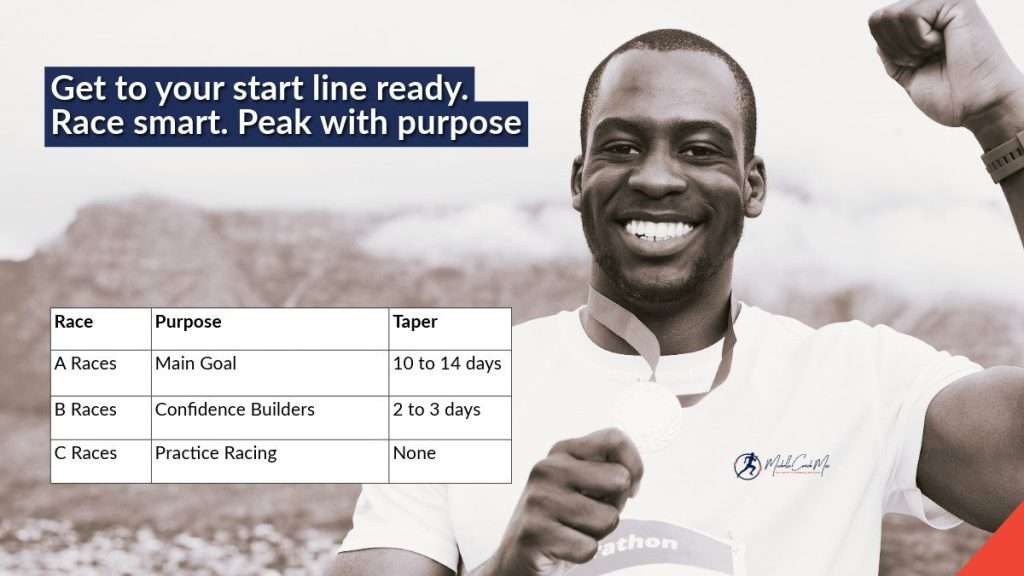
Using race prioritisation properly ensures you hit your A races in the best shape possible, while still gaining the experience and fitness benefits from your B and C events throughout the season.
Train in Cycles and Take Smart Breaks
Training throughout the year does not mean pushing hard all the time. Structured cycles and controlled rest help refresh the body and mind.
A solid rhythm includes:
- A 6-week cycle followed by a mini break
- A 12-week cycle followed by a slightly longer reset
These short breaks maintain momentum without losing fitness. Taking a full month off puts runners too far back and makes restarting much harder.
Think Long Term to Improve Every Year
When you stack consistent training cycles, smart rest periods, regular B races with gradual speed improvements, your marathon and ultra-marathon performances progress naturally. Year after year, you become stronger, fitter, and faster – not through dramatic changes but through disciplined and sustainable training.
Ready to join our running group and sign up for a training programme? Get in touch with Coach Michelle Mee
This is the real secret to breakthrough results.

Training for an ultra-marathon is a long-term journey that requires physical strength, mental resilience, and the right support. Whether your goal is the iconic Two Oceans Ultra Marathon or the world-famous Comrades Marathon, a structured ultra-marathon training plan can help you prepare efficiently and avoid the common pitfalls many runners face.
This guide explores key principles of ultra-marathon preparation, including race planning, training phases, strength development and the role of community. At Michelle Coach Mee (MCM), we work with athletes of all levels across South Africa and provide guidance grounded in experience, research, and real-world results.
Choosing the right races for your ultra-marathon training season
Selecting the correct build-up races is one of the most effective ways to support your ultra-marathon training strategy. These events help you practise pacing, test fuelling, measure your progress and prepare your body for the demands of Two Oceans or Comrades. Here are some of the key races many South African runners include in their preparation:
- Two Oceans Ultra Marathon (56 km) – A major early-season test with climbing, camber and beautiful but challenging terrain. Ideal for practising controlled pacing and learning how your body manages extended climbs.
- Om Die Dam (50 km) – A tougher route that builds strength and resilience. The steady climbs and late-race demands make it excellent preparation for Comrades.
- Loskop Ultra Marathon (50 km) – A scenic race with a strong rhythm that helps runners practise consistency and mental focus before entering peak training.
- False Bay 50 km – A well-balanced and fast course that helps runners refine pacing, practise nutrition and build late-season strength.
- Comrades Marathon (89 km) – South Africa’s ultimate road running challenge. Whether aiming for your first Vic Clapham or a Bill Rowan or better, your Comrades training plan should include progressive long runs, strength work and strategic recovery.
Using these races at the right points in the season helps build the fitness, confidence and experience needed for ultra success. Not sure where to start? Get in touch to find out which races to choose for your goals.
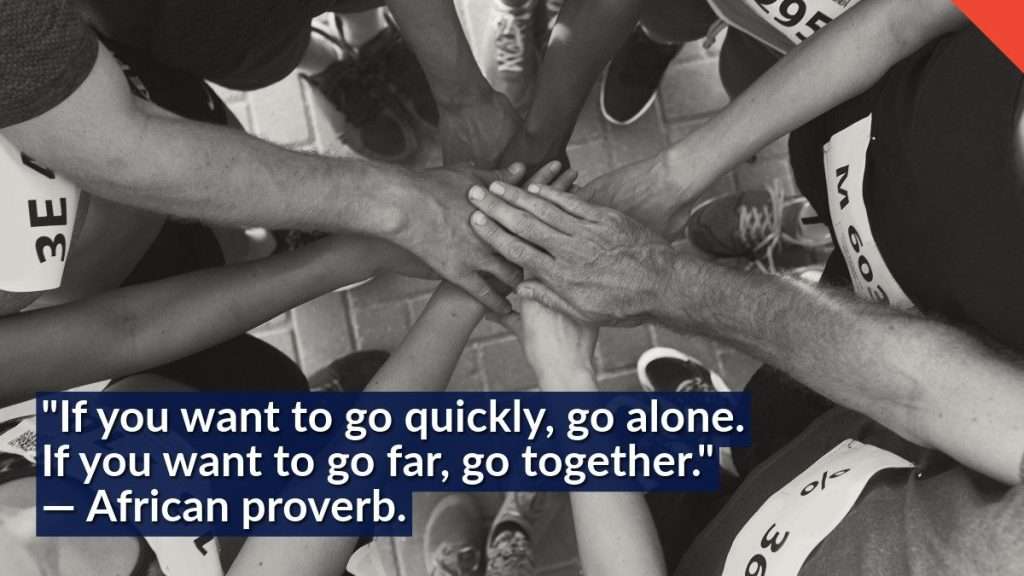
Why community matters in ultra-marathon training?
Ultra-marathon training can feel intimidating, especially for first-time runners. The long runs, early mornings, and higher mileage weeks often require more support than a traditional marathon plan provides.
Training with an ultra-marathon community can make a significant difference. Runners who follow a structured plan with others tend to stay more consistent and feel more motivated throughout the season’s peaks and troughs.
A supportive ultra-marathon training group offers:
- Accountability when motivation dips
- Shared knowledge and experience from seasoned ultra runners
- Support and safety on long runs
- Realistic pacing guidance
- Encouragement during heavy training loads
- A sense of belonging, especially during tougher training blocks
Being part of a running community helps make the journey more sustainable and rewarding.
Key elements of effective ultra-marathon training
Ultra-marathon success depends on more than mileage. Here are the core components of a balanced and effective training approach.
- A Personalised Ultra Training Plan: An ultra-marathon training plan should reflect your current fitness, experience, racing goals, weekly schedule, and any injuries. A one-size-fits-all approach can lead to burnout or under training.
- Guidance from an Experienced Ultra or Comrades Running Coach: Experienced coaching can help you avoid common training errors, such as pacing too hard, inadequate recovery, or misjudging qualifying requirements for the Comrades Marathon.
- Integrated Strength Training: Functional strength improves running economy, supports endurance, and reduces injury risk. Strength work is essential for ultra-marathon training.
- Race Selection and Qualification Planning: Many runners need help choosing the best qualifying marathon for Comrades or scheduling long training races. Good planning reduces stress and keeps your season on track.
- Group Support and Communication: Training with others provides motivation, route updates, safety, and guidance during demanding blocks such as back-to-back long runs.
- A Clear Comrades Training Roadmap: Understanding the structure of your training year, including base, build, peak and recovery phases, helps you train with purpose and avoid unnecessary panic.
The ultra-marathon training roadmap for Comrades
Below is a simplified overview of the phases used by many experienced ultra runners and coaches, including the approach used within the MCM premium training structure.
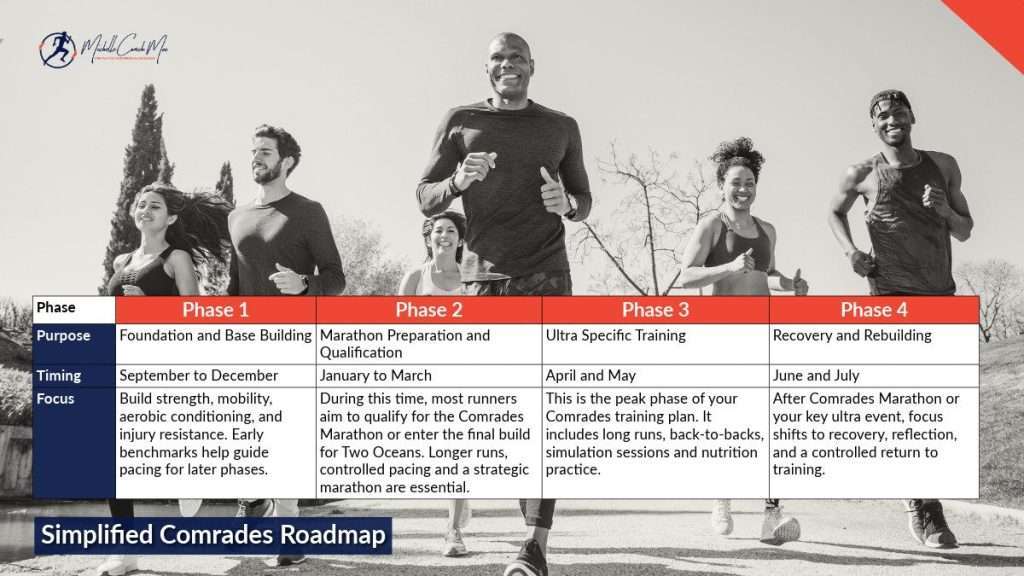
Understanding these phases helps runners prepare more intelligently and confidently. To find out more about our phased approach and how it can improve your consistency, read our article on how consistent year-round training can improve your running.
Qualifying for Comrades or preparing for Two Oceans Ultra Marathons
With Comrades Marathon entries filling up quickly every year, many runners feel pressured to secure a qualifying time. But qualification is more manageable with good planning. If you need a qualifying race, choosing the right marathon and training approach helps reduce the risk of injury and fatigue. If you miss an entry, substitution windows later in the season give runners a second chance, and staying consistent now means you remain ready. Our coaches can help you achieve your Comrades Ultra Marathon goals with a specialised training plan.
Ready to start your ultra-marathon training journey?
Reaching your ultra goals begins with structure, consistency and support you can trust. Our coaching provides clarity in your training and confidence in your progress, whether you are chasing a qualifier or building towards Comrades.
If you are ready to take the next step, complete the form and we will help you set up a personalised plan for your ultra season.

If the Shoe Fits
January and February are shoe month for marathon and ultra marathon runners. If you are running a marathon, Comrades, Two Oceans, Loskop etc you need to read this! Please make sure by the end of February you have established which brand and model of shoe you are going to run in for your qualifying marathon, long club run, Two Oceans and Comrades.
Go buy shoes at the end of February! Buy at least one new pair (if budget allows, buy 2 pairs*) of your chosen pair of shoes. Shoe manufacturer’s may change your favourite shoe by introducing a new version which is not the same as the current version you own. Slight changes in version may not work for you. As the season progresses towards the big Ultra races, the stores may run out of your size. Control the controllables, like your shoes, your training programme, your diet, your rest and your most importantly your stress levels. The weather is not in your hands but your shoes are. I have seen runners place themselves in unnecessary stress a week before a big goal race searching frantically for a new pair of racing shoes.
Once you have made your purchase of your favourite pair of running shoes, run a few club runs and maybe your qualifying marathon in your new shoes. Roughly clock up 200km on your “chosen” shoes. Your shoes will reach that point when they feel like marshmallows wrapping your feet and toes like a soft baby blanket and the sole will soothe your soul while the miles click by easily. It’s time to carefully lay them in a safe space in your cupboard. They are race ready. After all the hard miles of training and the battle lines have been drawn and you start that final two weeks of tapering, go to the cupboard, it’s time to bring out your “chosen” ones. Your last 2 weeks of race preparation before your BIG race must be done in your “chosen” shoes. Good luck and have a great race.
*The advantage of buying 2 pairs is that you can rotate your current shoes with one of the two new pairs.
Shoe Rotation Reduces Injury Risk
According to an article published in the Runnerworld (5 Dec 2013) written by Scott Douglas, a study shows there is evidence that rotating shoes can lower the injury risk. For further reading on this please click on the link below:
https://www.runnersworld.com/health-injuries/a20820451/study-backs-rotating-shoes-to-lower-injury-risk/
Please contact me if you have any shoe related questions or require any additional advice. I love to talk shoes!

What time should you be targeting in a 5km TT (Time Trial) to qualify for a specific seeding at Comrades or Two Oceans?
Yes, your 42.2km qualifying race time boils down to the speed you can race a 5km TT and subsequently this time equates to your half and full marathon times.
In late June and July, most ultra-distance runners would be resting on their couches, legs up, watching the Tour De France, IPL and Super Rugby having completed the ultra marathon road season. However, 2020 has not panned out to be “normal”. This means that all distance runners have the opportunity over the winter season to improve their 5km and 10km race times by going through a full-strength and speed training season. This means you have a chance to run a faster qualifying marathon.
Comrades and Two Oceans Tables (see below) with qualifying times.

It’s important to break down the qualifying times into attainable goals.
I have taken Comrades and Two Oceans qualifying times by seeding and used Jack Daniels tables to determine your equivalent T Pace, 5km, 10km and 21.1km times to reach a certain seeding.
- A 10km race is an extension of a 5km, hence your 5km TT will give you a fairly accurate indication of your 10km time.
- A 21km race is an extension of a 10km and your 10km race time will give you a good prediction of your 21.1km race time.
- Your 21.1km time will give you a good indication of your marathon time. Therefore, use your half marathon time to give you a target time for your marathon.
Focus on getting your 5km equivalent time, then attempt the 10km followed by the 21.1km.
Remember, it is early in the season and you can go back and keep trying to improve on these times.
Marathon 1 – Qualify
Use your first marathon to secure the qualifying time for your goal race.
If you are at high risk of not meeting the qualifying time, try to run your first qualifying race as early as possible but make sure you are marathon ready.
“Try get it right and qualify first time.”
Marathon 2 or Ultra Marathon – Back up Qualifier or improve on seeding
If for some reason you failed to qualify, ensure your back up marathon in no later than end January (Two Oceans – 3 April) and mid March (Comrades – 13 June).
If you have qualified but want to improve on your time, ensure this is done no later than mid April. A 48km race has the most lenient qualifying times as you get an extra 1 hour to run an additional 5.8km.
Irene 48km and Loskop 50 are ideal races to improve your seeding.
Example – An athlete has a T Pace of 4m54 and has recently run a 23m20 for 5km and 1h47m for 21.1km. The athlete is close to a Comrades “C” seeding and needs to get their 5km closer to 23m00. With the correct speed and endurance this will improve their 10km and 21km times which will allow the athlete to go for a C seeding.
Qualifying Marathon Targets
- Qualifying marathon 1 target – Kaapsehoop, D seeding (Secure qualifying into goal race)
- Qualifying marathon 2 target – Vaal, D seeding if for any reason did not qualify at Kaapsehoop. Or if they did qualify then try for a C seeding.
- Qualifying marathon 3 – Irene or Loskop, C seeding

The MCM Approach to an Ultra
- Make the decision to run Comrades/Two Oceans (commit to the goal)
- Enter the race (cement the goal)
- Plan your Comrades/Two Oceans training strategy (work towards the goal)
- What times do I need to run, to reach or exceed the goal? Break the goal down into manageable bite sizes ie: Set short-term milestones.
- Stay focused on the goal. Buckle your seat belts, it’s going to be a roller coaster ride.
- Be accountable (coach/logbook/ training mates), this will help you stay on track to reach your goal.
Qualifying for Two Oceans and Comrades
Last week I broke down the qualifying times into race times, today we are looking at what pace you need to train and run races from 5km to 50km to be able to aim for your medal.
The runner you are today is not the runner who will be standing on the start line. You will have undergone a huge transformation during your ultra-distance training season.
Your Two Oceans/Comrades time is based on your demonstrated race times over a few different distances in the 3-5 months leading up to the race.
Pacing Guidelines for Two Oceans and Comrades
Below is a guideline as to the race times and T Pace you need to achieve to reach certain medals. Some runners can run slower times over shorter distances and achieve their desired medal as they are naturally more economical over a longer distance than an average runner. Others will need to run faster over shorter distances as they are less economical the further the distance.


Are you thinking of running Comrades Marathon in 2026? Your pre-Comrades training starts now… if you are a novice or Comrades veteran, we can help you cross that finish line and have the plan and race strategy to suit your Comrades Marathon journey.
What’s in the Comrades Training Plan?
- Weekly training programme on Training Peaks tailored to your current fitness.
- Updated fitness and race data.
- Group training sessions.
- Milestone race plan to reach Comrades goals.
- Comrades race strategy.
- Nutrition guidelines
- Specialised preparation training runs
Michelle Coach Mee (MCM) Comrades group
As a member of the MCM Comrades group you also get
- Exclusive content on a closed FB page.
- 1 hour Face to Face interactive session per month.
- Free Training Peaks Basic Package.
Looking for a Comrades Coach?
Michelle Mee is a Top 20/2nd Vet and Silver Medal Comrades finisher. She has coached hundreds of athletes to achieve their goals successfully. Find out more about Coach Michelle Mee, or if you’re ready to go the distance, check out our MCM guide to ultra-marathon training.
Let me make your Comrades goals a reality! WhatsApp me today!
